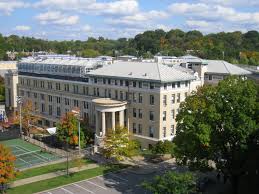
The University of Texas at Austin, informally UT Austin, UT, University of Texas, or Texas in sports contexts, is a public research university and the flagship institution of The University of Texas System. Founded in 1883 as "The University of Texas," its campus is located in Austin—approximately 1 mile (1,600 m) from the Texas State Capitol. The institution has the fifth-largest single-campus enrollment in the nation, with over 50,000 undergraduate and graduate students and over 24,000 faculty and staff. The university has been labeled one of the "Public Ivies," a publicly funded university considered as providing a quality of education comparable to those of the Ivy League.
UT Austin was inducted into the American Association of Universities in 1929, becoming only the third university in the American South to be elected. It is a major center for academic research, with research expenditures exceeding $550 million for the 2013–2014 school year. The university houses seven museums and seventeen libraries, including the Lyndon Baines Johnson Library and Museum and the Blanton Museum of Art, and operates various auxiliary research facilities, such as the J. J. Pickle Research Campus and the McDonald Observatory. Among university faculty are recipients of the Nobel Prize, Pulitzer Prize, the Wolf Prize, and the National Medal of Science, as well as many other awards.
UT Austin student athletes compete as the Texas Longhorns and are members of the Big 12 Conference. Its Longhorn Network is unique in that it is the only sports network featuring the college sports of a single university. The Longhorns have won four NCAA Division I National Football Championships, six NCAA Division I National Baseball Championships and has claimed more titles in men's and women's sports than any other school in the Big 12 since the league was founded in 1996. Current and former UT Austin athletes have won 130 Olympic medals, including 14 in Beijing in 2008 and 13 in London in 2012. The university was recognized by Sports Illustrated as "America's Best Sports College" in 2002.
Monday, August 3, 2015
Georgia Institute of Technology
The Georgia Institute of Technology (commonly referred to as Georgia Tech, Tech, or GT) is a public research university in Atlanta, Georgia, in the United States. It is a part of the University System of Georgia and has satellite campuses in Savannah, Georgia; Metz, France; Athlone, Ireland; Shanghai, China; and Singapore.
The educational institution was founded in 1885 as the Georgia School of Technology as part of Reconstruction plans to build an industrial economy in the post-Civil War Southern United States. Initially, it offered only a degree in mechanical engineering. By 1901, its curriculum had expanded to include electrical, civil, and chemical engineering. In 1948, the school changed its name to reflect its evolution from a trade school to a larger and more capable technical institute and research university.
Today, Georgia Tech is organized into six colleges and contains about 31 departments/units, with emphasis on science and technology. It is well recognized for its degree programs in engineering, computing, business administration, the sciences, architecture, and liberal arts.
Georgia Tech's main campus occupies part of Midtown Atlanta, bordered by 10th Street to the north and by North Avenue to the south, placing it well in sight of the Atlanta skyline. The campus was the site of the athletes' village and a venue for a number of athletic events for the 1996 Summer Olympics. The construction of the Olympic village, along with subsequent gentrification of the surrounding areas, enhanced the campus.
Student athletics, both organized and intramural, are a part of student and alumni life. The school's intercollegiate competitive sports teams, the four-time football national champion Yellow Jackets, and the nationally recognized fight song "Ramblin' Wreck from Georgia Tech", have helped keep Georgia Tech in the national spotlight. Georgia Tech fields eight men's and seven women's teams that compete in the NCAA Division I athletics and the Football Bowl Subdivision. Georgia Tech is a member of the Coastal Division in the Atlantic Coast Conference.
The educational institution was founded in 1885 as the Georgia School of Technology as part of Reconstruction plans to build an industrial economy in the post-Civil War Southern United States. Initially, it offered only a degree in mechanical engineering. By 1901, its curriculum had expanded to include electrical, civil, and chemical engineering. In 1948, the school changed its name to reflect its evolution from a trade school to a larger and more capable technical institute and research university.
Today, Georgia Tech is organized into six colleges and contains about 31 departments/units, with emphasis on science and technology. It is well recognized for its degree programs in engineering, computing, business administration, the sciences, architecture, and liberal arts.
Georgia Tech's main campus occupies part of Midtown Atlanta, bordered by 10th Street to the north and by North Avenue to the south, placing it well in sight of the Atlanta skyline. The campus was the site of the athletes' village and a venue for a number of athletic events for the 1996 Summer Olympics. The construction of the Olympic village, along with subsequent gentrification of the surrounding areas, enhanced the campus.
Student athletics, both organized and intramural, are a part of student and alumni life. The school's intercollegiate competitive sports teams, the four-time football national champion Yellow Jackets, and the nationally recognized fight song "Ramblin' Wreck from Georgia Tech", have helped keep Georgia Tech in the national spotlight. Georgia Tech fields eight men's and seven women's teams that compete in the NCAA Division I athletics and the Football Bowl Subdivision. Georgia Tech is a member of the Coastal Division in the Atlantic Coast Conference.
University of Washington
The University of Washington (UW), commonly referred to as Washington or informally U-Dub, is a public research university in Seattle, Washington, United States. Founded in 1861, UW is one of the oldest universities on the West Coast and features one of the most highly regarded medical schools in the world. UW has been labeled one of the "Public Ivies," a publicly funded university considered as providing a quality of education comparable to those of the Ivy League.
The university has three campuses: the primary and largest in the University District of Seattle and two others in Tacoma and Bothell. Its operating expenses and research budget for fiscal year 2014-15 is expected to be $6.4 billion. The UW occupies over 500 buildings, with over 20 million gross square footage of space, including the University of Washington Plaza, consisting of the 325-foot (99 m) UW Tower and conference center.
Washington is an elected member of the Association of American Universities, and its research budget is among the highest in the United States. In athletics, the university competes in the NCAA Division I Pacific-12 Conference (Pac-12).
The university has three campuses: the primary and largest in the University District of Seattle and two others in Tacoma and Bothell. Its operating expenses and research budget for fiscal year 2014-15 is expected to be $6.4 billion. The UW occupies over 500 buildings, with over 20 million gross square footage of space, including the University of Washington Plaza, consisting of the 325-foot (99 m) UW Tower and conference center.
Washington is an elected member of the Association of American Universities, and its research budget is among the highest in the United States. In athletics, the university competes in the NCAA Division I Pacific-12 Conference (Pac-12).
National University of Singapore
The National University of Singapore (Abbreviation: NUS) is a university located in Singapore. Founded in 1905, it is the oldest higher learning institute in Singapore, as well as the largest university in the country in terms of student enrolment and curriculum offered. It is ranked as one of the best universities in Asia, placing 22nd in the world and 1st in Asia in the 2014 QS rankings.Conversely, the Academic Ranking of World Universities ARWU ranking system that measures universities academic achievements and research performance consistently placed NUS in the range of 100–150 world wide. The university's main campus is located in southwest Singapore at Kent Ridge, with an area of approximately 1.83 km2 (0.71 sq mi). The Bukit Timah campus houses the Faculty of Law, Lee Kuan Yew School of Public Policy and research institutes, while the Duke-NUS Graduate Medical School Singapore is located at the Outram campus.
Carnegie Mellon Univeersity
Carnegie Mellon University (Carnegie Mellon or CMU; /ˈkɑrnɨɡi ˈmɛlən/ or /kɑrˈneɪɡi ˈmɛlən/) is a private research university in Pittsburgh, Pennsylvania.
The university began as the Carnegie Technical Schools founded by Andrew Carnegie in 1900. In 1912, the school became the Carnegie Institute of Technology and began granting four-year degrees. In 1967, the Carnegie Institute of Technology merged with the Mellon Institute of Industrial Research to form Carnegie Mellon University. The university's 140-acre (57 ha) main campus is 3 miles (4.8 km) from Downtown Pittsburgh and abuts the Carnegie Museums of Pittsburgh, the main branch of the Carnegie Library of Pittsburgh, the Carnegie Music Hall, Schenley Park, Phipps Conservatory and Botanical Gardens, the Pittsburgh Golf Club, and the campus of the University of Pittsburgh in the city's Oakland and Squirrel Hill neighborhoods, partially extending into Shadyside.
Carnegie Mellon has seven colleges and independent schools: the College of Engineering, College of Fine Arts, Dietrich College of Humanities and Social Sciences, Mellon College of Science, Tepper School of Business, H. John Heinz III College and the School of Computer Science.
First year students are required to live on campus and 75% of undergraduates remain in the on-campus house system. Carnegie Mellon fields 17 varsity athletic teams as part of the University Athletic Association conference of the NCAA Division III.
The university began as the Carnegie Technical Schools founded by Andrew Carnegie in 1900. In 1912, the school became the Carnegie Institute of Technology and began granting four-year degrees. In 1967, the Carnegie Institute of Technology merged with the Mellon Institute of Industrial Research to form Carnegie Mellon University. The university's 140-acre (57 ha) main campus is 3 miles (4.8 km) from Downtown Pittsburgh and abuts the Carnegie Museums of Pittsburgh, the main branch of the Carnegie Library of Pittsburgh, the Carnegie Music Hall, Schenley Park, Phipps Conservatory and Botanical Gardens, the Pittsburgh Golf Club, and the campus of the University of Pittsburgh in the city's Oakland and Squirrel Hill neighborhoods, partially extending into Shadyside.
Carnegie Mellon has seven colleges and independent schools: the College of Engineering, College of Fine Arts, Dietrich College of Humanities and Social Sciences, Mellon College of Science, Tepper School of Business, H. John Heinz III College and the School of Computer Science.
First year students are required to live on campus and 75% of undergraduates remain in the on-campus house system. Carnegie Mellon fields 17 varsity athletic teams as part of the University Athletic Association conference of the NCAA Division III.
Northwestern University
Northwestern University (NU) is a private research university with campuses in Evanston and Chicago in Illinois, United States, as well as Doha, Qatar. Composed of twelve schools and colleges, Northwestern offers 124 undergraduate degrees and 145 graduate and professional degrees.
Northwestern was founded in 1851 by John Evans, for whom the City of Evanston is named, and eight other lawyers, businessmen and Methodist leaders. Its founding purpose was to serve the Northwest Territory, an area that today includes the states of Ohio, Indiana, Illinois, Michigan, Wisconsin and parts of Minnesota. Instruction began in 1855; women were admitted in 1869. Today, the main campus is a 240-acre (97 ha) parcel in Evanston, along the shores of Lake Michigan just 12 miles north of downtown Chicago. The university's law and medical schools are located on a 25-acre (10 ha) campus in Chicago's Streeterville neighborhood. In 2008, the university opened a campus in Education City, Doha, Qatar with programs in journalism and communication.
Northwestern is a large research university with a comprehensive doctoral program and attracts over $550 million in sponsored research each year. In addition, Northwestern has one of the largest university endowments in the United States, currently valued at $9.8 billion. In 2015, the university accepted 13% of undergraduate applicants, making Northwestern one of the most selective universities in the country.
Northwestern is a founding member of the Big Ten Conference and remains the only private university in the conference. The Northwestern Wildcats compete in 19 intercollegiate sports in the NCAA's Division I Big Ten Conference.
Northwestern was founded in 1851 by John Evans, for whom the City of Evanston is named, and eight other lawyers, businessmen and Methodist leaders. Its founding purpose was to serve the Northwest Territory, an area that today includes the states of Ohio, Indiana, Illinois, Michigan, Wisconsin and parts of Minnesota. Instruction began in 1855; women were admitted in 1869. Today, the main campus is a 240-acre (97 ha) parcel in Evanston, along the shores of Lake Michigan just 12 miles north of downtown Chicago. The university's law and medical schools are located on a 25-acre (10 ha) campus in Chicago's Streeterville neighborhood. In 2008, the university opened a campus in Education City, Doha, Qatar with programs in journalism and communication.
Northwestern is a large research university with a comprehensive doctoral program and attracts over $550 million in sponsored research each year. In addition, Northwestern has one of the largest university endowments in the United States, currently valued at $9.8 billion. In 2015, the university accepted 13% of undergraduate applicants, making Northwestern one of the most selective universities in the country.
Northwestern is a founding member of the Big Ten Conference and remains the only private university in the conference. The Northwestern Wildcats compete in 19 intercollegiate sports in the NCAA's Division I Big Ten Conference.
University of Toronto
The University of Toronto (U of T, UToronto, or Toronto) is a public research university in Toronto, Ontario, Canada, situated on the grounds that surround Queen's Park. It was founded by royal charter in 1827 as King's College, the first institution of higher learning in the colony of Upper Canada. Originally controlled by the Church of England, the university assumed the present name in 1850 upon becoming a secular institution. As a collegiate university, it comprises twelve colleges that differ in character and history, each retaining substantial autonomy on financial and institutional affairs. It has two satellite campuses located in Scarborough and Mississauga.
Academically, the University of Toronto is noted for influential movements and curricula in literary criticism and communication theory, known collectively as the Toronto School. The university was the birthplace of insulin and stem cell research, and was the site of the first practical electron microscope, the development of multi-touch technology, the identification of Cygnus X-1 as a black hole, and the theory of NP completeness. By a significant margin, it receives the most annual research funding of any Canadian university. It is one of two members of the Association of American Universities located outside the United States.
The Varsity Blues are the athletic teams representing the university in intercollegiate league matches, with particularly long and storied ties to gridiron football and ice hockey. The university's Hart House is an early example of the North American student centre, simultaneously serving cultural, intellectual and recreational interests within its large Gothic-revival complex.
The University of Toronto has educated two Governors General and four Prime Ministers of Canada, four foreign leaders, fourteen Justices of the Supreme Court, and has been affiliated with ten Nobel laureates.
Academically, the University of Toronto is noted for influential movements and curricula in literary criticism and communication theory, known collectively as the Toronto School. The university was the birthplace of insulin and stem cell research, and was the site of the first practical electron microscope, the development of multi-touch technology, the identification of Cygnus X-1 as a black hole, and the theory of NP completeness. By a significant margin, it receives the most annual research funding of any Canadian university. It is one of two members of the Association of American Universities located outside the United States.
The Varsity Blues are the athletic teams representing the university in intercollegiate league matches, with particularly long and storied ties to gridiron football and ice hockey. The university's Hart House is an early example of the North American student centre, simultaneously serving cultural, intellectual and recreational interests within its large Gothic-revival complex.
The University of Toronto has educated two Governors General and four Prime Ministers of Canada, four foreign leaders, fourteen Justices of the Supreme Court, and has been affiliated with ten Nobel laureates.
Subscribe to:
Posts (Atom)